Estonia has 19 higher education institutions — six public universities, one private university and twelve professional institutions — teaching a little over 45,000 students in 2025/26. Six matter to almost every international applicant, and the differences between them are larger than the size of the country suggests: one charges EU citizens nothing for English-taught engineering, another €9,800 a year for veterinary medicine.
Tuition is €0 in Estonian and €3,800–€9,800 in English. Any full-time degree taught in Estonian at a public university is free, to everyone, with no nationality condition, and doctoral study is free in any language.
English-taught degrees are free for EU citizens at TalTech outside the business school, and across much of the University of Tartu. For everyone else they run from about €3,800 to €9,800 a year depending on the field — and from the 2026/27 intake Tartu no longer offers tuition waivers to newly admitted non-EU students at all.
The cohort is shrinking while the inflow recovers: 3,954 international degree students in 2024/25, against 4,340 (9.7% of all students) in 2023/24 and 5,072 in 2021/22, while new enrolments rose from 1,191 to 1,251. The Ministry of Education names four causes: sanctions after the 2022 invasion of Ukraine cut Russian students by 65%, the EU-funded Dora Plus scholarship ended, visa refusals for third-country nationals rose, and Estonia has fewer embassies issuing visas.
The institutions
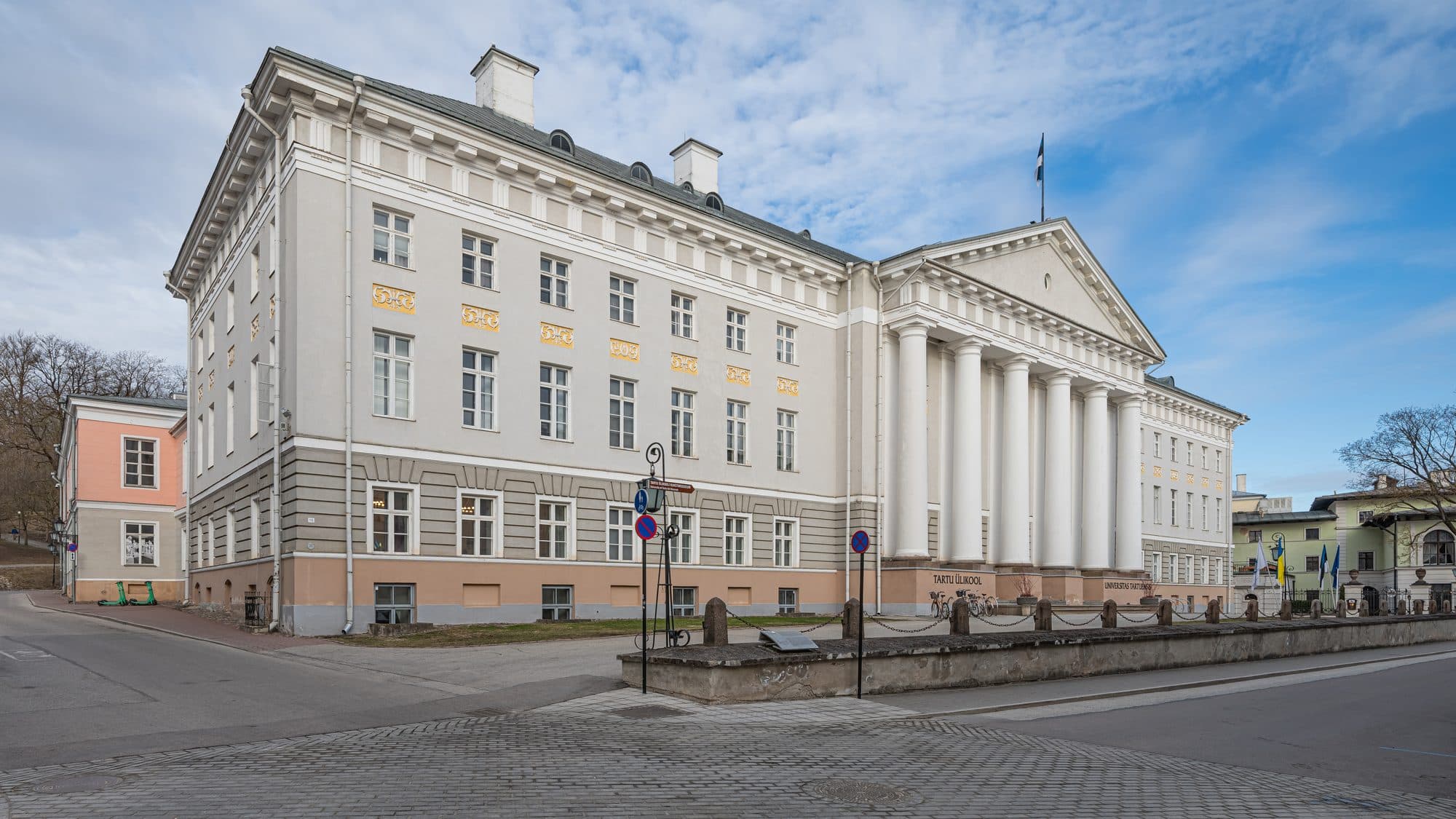
The building on Ülikooli street is the one every Tartu prospectus photographs, and the university behind it is why a third of this city is students.
| Institution | Students | International | English-taught | Where |
|---|---|---|---|---|
| University of Tartu | 15,573 | 1,435 (9.2%) | 30 at BA and MA level | Tartu, plus colleges in Narva, Pärnu and Viljandi |
| TalTech | ~9,929 | 797 (8.4%) | 4 bachelor's, 14 master's | Tallinn |
| Tallinn University | ~7,000 | 658 | 38 | Tallinn, plus Haapsalu College |
| Estonian Academy of Arts | 1,165 | 120 | 8 master's, 4 international doctoral | Tallinn |
| Estonian University of Life Sciences | ~3,000 | ~300 | 3 degree, 5 doctoral | Tartu |
| Estonian Business School | ~1,500 | 520 (35%) | — | Tallinn, plus a Helsinki campus |
What each is actually good at
Their own claims, and the checkable ones:
- Tartu — the research university. 49% of its international students are at master's level and 25% doctoral, so the undergraduate experience is not the point.
- TalTech — engineering and IT, 50+ high-tech companies on campus, and the EuroTeQ network giving access to courses at other European technical universities.
- Tallinn University — the humanities and social sciences counterweight, and the only one where every student must complete an interdisciplinary project course to graduate.
The specialists
Small, and the only option in their field:
- Estonian Academy of Arts — Estonia's only public visual arts university, about 1,165 students to 300 teaching staff.
- Life Sciences — founded 1848, 93rd in the world in agriculture and forestry, and where veterinary medicine is taught.
- Estonian Business School — private, founded 1988, and the most international institution in the country by share.
Two of the University of Tartu's colleges sit in cities this site covers in their own right: Narva College with 812 students and Pärnu College with 810. Together with the Viljandi Culture Academy's 753, the colleges are 15% of the university. See Narva and Pärnu for what living there is like.
What tuition costs
| Institution and programme | Per year | Notes |
|---|---|---|
| TalTech, English-taught | €3,800 – €8,400 | Free for EU citizens outside the business school |
| TalTech, School of Engineering | €6,000 | Free for EU citizens |
| TalTech, School of IT | €7,000 | Free for EU citizens |
| Tallinn University, bachelor's | €4,200 – €5,400 | Doctoral study is free |
| Tallinn University, master's | €3,800 – €5,000 | Two programmes price EU and non-EU differently |
| Academy of Arts, master's | €2,000 – €8,000 | Application fee €80 |
| Life Sciences, Landscape Architecture | €4,000 | Application fee €100 |
| Life Sciences, Environmental Governance | €5,600 | Targeted free places exist |
| Life Sciences, Veterinary Medicine | €9,800 | The most expensive published fee in Estonia |
| University of Tartu | €4,000 – €13,200 | Press-reported — confirm with the university |
Two mechanics before you sign anything. TalTech may raise fees for continuing students by up to 10% a year, with rates set by Senate decision at least four months before the academic year begins — so the number in your offer letter is a floor, not a fixed price. And part-time study is charged per credit point everywhere, including on Estonian-taught programmes that are free full-time; at Tartu that is the difference between €0 and a bill.
Application fees are separate and non-refundable: €100 at Tartu, €80 at the Academy of Arts, €100 at Life Sciences for the fee-charging programmes. Tartu waives it for Estonian citizens, for anyone educated in Estonia and for previous applicants; the Academy of Arts waives it if you already hold an Estonian degree or a recognised foreign one.
Studying free
The Estonian-language route has no nationality test. The Ministry of Education's rule is that higher education is free for those studying full-time and in Estonian. Citizenship is not part of it. A non-EU student admitted to an Estonian-taught degree at a public university pays €0 and is charged nothing at any point — and only about 6% of international students take that route.
Three ways to pay nothing, in order of how many people can actually use them:
- An Estonian-taught full-time degree. Free to all. Requires the language first, which is the real barrier — see the Estonian language.
- Doctoral study. Free in any language at every public university, and PhD students admitted from 2022/23 also get automatic state health insurance. This is the best-value route into Estonia that exists and it is why 41% of doctoral candidates here are not Estonian.
- An EU passport and the right university. TalTech charges EU citizens nothing for English-taught study outside its business school. Tartu makes Science and Technology and most of Arts and Humanities free to EU citizens, halves Social Sciences, and charges full fees in Medicine — 16 of its 25 international master's curricula are free to EU citizens.
The limits apply to everyone, Estonians included. You pay if you have previously studied tuition-free for at least 365 days at the same level and fewer than 10 years have passed since you left. And a 2024/25 amendment bars enrolling tuition-free more than 2 times at the same level within ten years — including on English-taught tuition-waiver places. Teacher education and doctoral study are exempt from both, and eligibility is checked against the national education register at admission, so it is not a question anyone gets to answer for themselves.
Scholarships, and two that no longer exist
| Scheme | Amount | Who | Status |
|---|---|---|---|
| Harno degree and exchange scholarship | €350/month (BA, MA), €660/month (doctoral) | Foreign students. Bachelor's only for Estonian language and culture; master's and doctoral in any field | Open — about 10% succeed |
| Harno summer school scholarship | Up to €700 course fee + €25/night, max 4 weeks | Students enrolled abroad for at least a year | Open, spring deadline |
| University waivers | 25% to 100% | Varies — TalTech's EU exemption, Tartu's tiered waivers, targeted free places at Life Sciences | Open, institution by institution |
| Dora Plus | €350/month | Was: non-Estonian full-time master's students | Ended 31 May 2023 |
| Needs-based study allowance | €440/month at the top band | Not holders of a study residence permit | Closed to you since 1 Aug 2022 |
Two dead schemes still listed all over the internet
Dora Plus ran from August 2015 to 31 May 2023 and stopped accepting incoming-student applications on 31 December 2022. Both the Ministry of Education and Harno name its end as a direct cause of the fall in international student numbers. It is still advertised as available on a great many study-abroad sites.
The needs-based study allowance (vajaduspõhine õppetoetus) stopped extending to holders of a temporary residence permit for study on 1 August 2022. The rates — €440, €270 and €150 a month by household income band, with a €135 special allowance — are real and current. They are simply not available on a study permit.
The Harno scholarship is the one national scheme genuinely open to foreign degree students, and it is competitive: roughly 10% of applicants get one, applications open in early September for the following academic year, and citizens of Russia and Belarus are not accepted.
The state-backed student loan — 1.99% plus six-month Euribor, no arrangement fee, maximum €6,000, available through Swedbank between 1 September and 31 May — is a national scheme tied to Estonian residency. Whether an international student on a study permit qualifies is not stated anywhere, so treat it as probably not until your bank tells you otherwise.
What changed for 2026/27
The University of Tartu ended tuition waivers for newly admitted non-EU students. Announced in March 2026, effective for the 2026/27 intake. In the same move Tartu introduced EU-tiered pricing: Science and Technology and most of Arts and Humanities free to EU citizens, Social Sciences at half price, Medicine at full fees. Non-EU students keep access only to limited 25%, 50% and 100% waivers on selected curricula, awarded semester by semester — and there are no tuition waivers at all on English-taught bachelor's programmes. The vice-rector's stated aim is to recruit more EU students and make English-taught study more sustainable.
Beyond fees, the 2026/27 admissions round added English-taught master's programmes across the system — bioengineering innovation and combined social sciences at Tartu; informatics and AI, strategic design and technology, and AI in business at TalTech; a philosophy, politics and economics bachelor's and a shortened teacher education master's at Tallinn University; industrial engineering, geodesy, real estate and land management at Life Sciences. Several programmes moved the other way, to fee-based, including public administration and business at Tallinn University.
Admissions procedure changed too, in a direction that favours applicants who interview well: mandatory academic tests were dropped for psychology undergraduates, Tallinn University eliminated written entrance exams, and motivation videos are replacing motivation letters, discussion tasks replacing essays.
You cannot defer
Students accepted at the University of Tartu cannot defer their place to the following year. If the permit timeline is tight — and at 90 days for a decision plus 30 for the card, it can be — that is a reason to apply in the earlier round rather than assume you can push the start back.
FAQ
How much is university in Estonia for international students?
Nothing at all for a full-time degree taught in Estonian, or for doctoral study in any language. English-taught degrees are free for EU citizens at TalTech outside its business school and across much of the University of Tartu, and otherwise run roughly €3,800–€9,800 a year: about €6,000 for TalTech engineering, €7,000 for IT, €4,200–€5,400 for Tallinn University bachelor's, and €9,800 for veterinary medicine.
Which is the best university in Estonia for international students?
It depends on the field rather than on ranking. The University of Tartu is the largest and the research university, with 30 English-taught programmes and students from 98 countries. TalTech is the engineering and IT university and is free to EU citizens outside its business school. Tallinn University is the humanities and social sciences option with 38 English-taught programmes. Veterinary medicine exists only at the Estonian University of Life Sciences, and visual arts only at the Estonian Academy of Arts.
Are there scholarships for international students in Estonia?
Yes, but fewer than there were. The national Harno scholarship pays €350 a month for bachelor's and master's students and €660 for doctoral candidates, with roughly a 10% success rate, and it is closed to citizens of Russia and Belarus. Universities run their own waivers. Dora Plus ended in 2023 and the needs-based state study allowance has been closed to study-permit holders since 2022 — both are still listed as available on many sites.
Can I study in Estonia in English?
Yes. All six public universities teach in English — around 30 programmes at Tartu, 38 at Tallinn University, 18 at TalTech, and smaller specialist portfolios at the Academy of Arts and the University of Life Sciences. English-taught study is what the great majority of international students do here; only about 6% study in Estonian.
I have already studied for free once — do I have to pay this time?
Possibly, and the rule applies to Estonians too. You pay if you have previously studied tuition-free for at least 365 days at the same level and fewer than 10 years have passed since you left. A 2024/25 amendment separately bars enrolling tuition-free more than 2 times at the same level within ten years, and that one counts English-taught tuition-waiver places as well. Teacher education and doctoral study are exempt from both, and eligibility is checked against the national education register at admission rather than declared by the applicant.
What changed at the University of Tartu for the 2026/27 intake?
Tartu ended tuition waivers for newly admitted non-EU students — announced in March 2026, effective for the 2026/27 intake — and introduced EU-tiered pricing in the same move: Science and Technology and most of Arts and Humanities free to EU citizens, Social Sciences at half price, Medicine at full fees. Non-EU students keep access only to limited 25%, 50% and 100% waivers on selected curricula, awarded semester by semester, and there are no tuition waivers at all on English-taught bachelor's programmes.
I have an offer but the timing is tight. Can I defer my place to next year?
Not at the University of Tartu — students accepted there cannot defer to the following year, and that is the institution most international applicants are dealing with. It matters because of the other clock: the study residence permit takes 90 days for a decision plus 30 for the card, so a place accepted late can collide with a start date you cannot move. Apply in the earlier admissions round rather than assume the start can be pushed back, and — since deferral policy is set institution by institution — confirm yours in writing.
Can I take the Estonian student loan?
Probably not. The state-backed student loan runs at 1.99% plus six-month Euribor with no arrangement fee, to a maximum of €6,000, and is available through Swedbank between 1 September and 31 May. It is a national scheme tied to Estonian residency, and its published terms do not say whether an international student holding a temporary residence permit for study qualifies, so treat it as unavailable until Swedbank tells you otherwise rather than building a budget on it. What is definitely open to you is the Harno scholarship and the universities' own waivers.
Do I still write a motivation letter, or has that changed?
It is changing, in a direction that favours applicants who present well live. For the 2026/27 round motivation videos are replacing motivation letters and discussion tasks are replacing essays; Tallinn University also eliminated written entrance exams, and mandatory academic tests were dropped for psychology undergraduates. Preparation shifts from drafting and redrafting a document to being able to talk about your subject on camera or in conversation, which is a different rehearsal.
Is the tuition figure in my offer letter what I will actually pay?
Treat it as a floor rather than a fixed price. TalTech may raise fees for continuing students by up to 10% a year, with rates set by Senate decision at least four months before the academic year begins. Part-time study is charged per credit point everywhere, including on Estonian-taught programmes that cost nothing full-time — at Tartu that is the difference between €0 and a bill. Application fees are separate and non-refundable on top: €100 at Tartu, €80 at the Academy of Arts and €100 at Life Sciences for the fee-charging programmes.