Pärnu has the best weather in Estonia and the weakest economy of the four cities here, and both are true by a clear margin in the published data. It is the cheapest place to buy, it has the lowest unemployment in the country, and it also has the lowest GDP per capita, no railway, no international flights and no newcomer service of any kind.
Table of Contents
About Pärnu
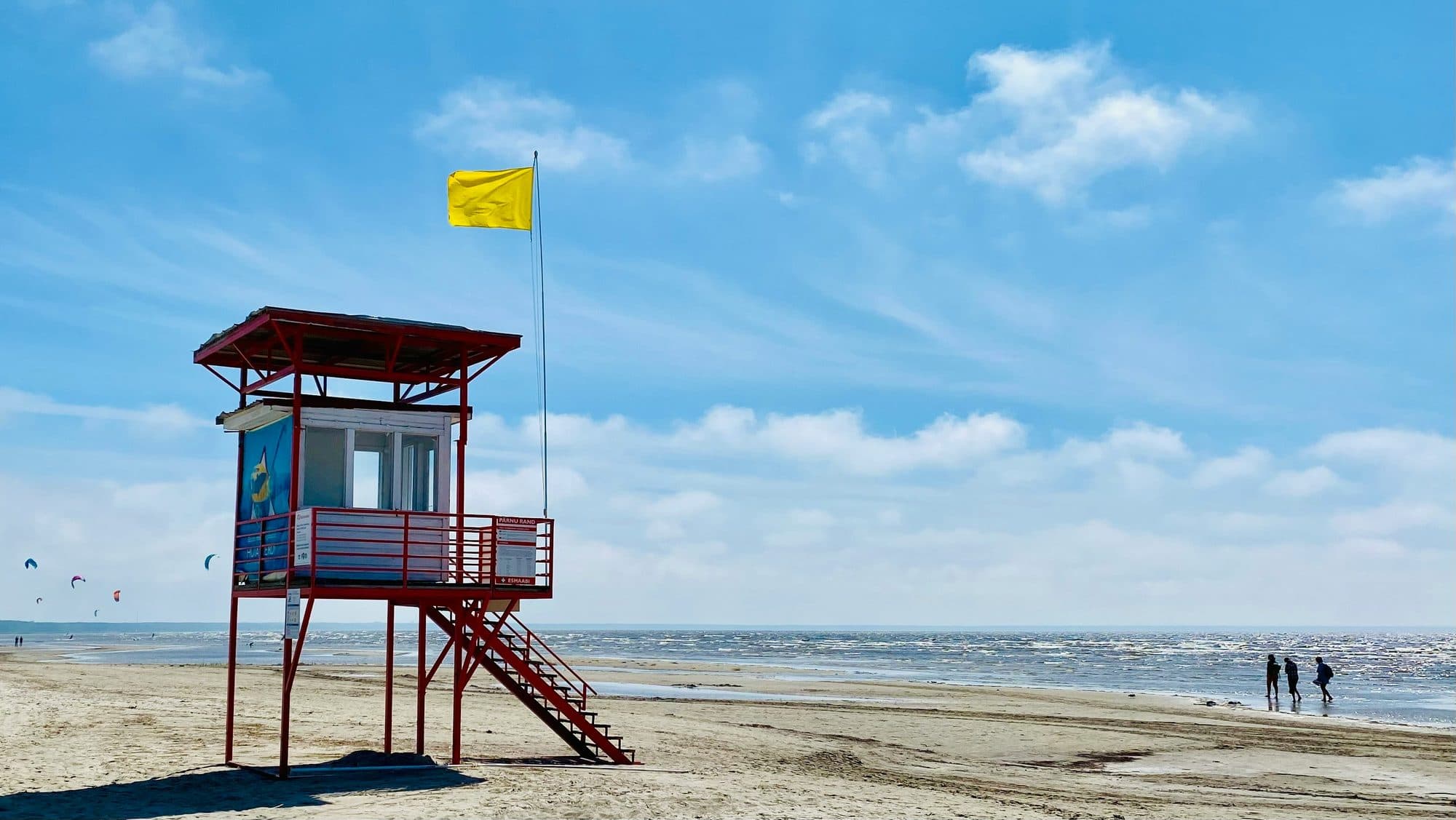
Pärnu's case rests almost entirely on the photograph, and that is both the appeal and the caveat. The beach is real, the summer is real, and so is the drop in activity once the season ends.
Two population figures are in circulation, both correct and twelve thousand apart. The city's own English page says 39,474 residents across 33.15 km². The Population Register says 51,333. Both are right: the smaller number is Pärnu city proper, dated 1 January 2022, while the larger is Pärnu linn the urban municipality, which since the 2017 reform swallowed the Audru, Paikuse and Tõstamaa borough districts. Any guide quoting both without explaining looks broken. This site uses the municipality figure, as it does for every city.
Pärnu grew by 932 in 2022, held flat through 2025, then fell by 444 — a gentler version of the national pattern.
Cost of Living
Pärnu is the cheapest of the three cities the land board publishes prices for.
| Pärnu | vs Tallinn | |
|---|---|---|
| Apartments, secondary market | €1,988.00/m² | -33% |
| Typical two-room flat | €94,551 | -31% |
| New build | €3,815.00/m² | -17% |
| District heating | €68.76/MWh | -12% |
| Water and sewerage | €3.84/m³ | +34% — the most expensive of the four |
A typical two-room flat is €41,775 cheaper than in Tallinn. Water is the one line where Pärnu is worst of the four, though on a tariff from July 2025.
Neighbourhoods
The one piece of orientation worth having from a primary source is scale: the city proper is 33.15 km² and Pärnu is 128 km from Tallinn and 180 km from Riga, both from the city's own general information page.
Job Market
Plenty of jobs, not much money. Pärnu county has the lowest registered unemployment of the four at 3.9%, well under the national 5.6% — and the lowest GDP per capita, at 67% of the national average. Its median wage of €1,446 is barely above Ida-Viru's €1,407, in a county with a fifth of Ida-Viru's unemployment. That tension is the single most important thing to understand about working here.
The city's own development plan gives the only city-level sector employment split published for any Estonian city — which makes it valuable, and it is from 2017, which makes it old. Dated accordingly:
| Sector | Share of workers | Average salary (2017) |
|---|---|---|
| Manufacturing | 29% | €895 |
| Wholesale and retail | 10% | €691 |
| Healthcare and social services | 9% | €687 |
| Hospitality | 9% | €564 |
The county development centre names nine key sectors today: metalwork (~50 companies, ~700 workers), electronics (1,000+ employees), wood — the region holds 30% of Estonia's forest resources — textiles, ICT, tourism and hospitality (six spas, 4,000+ hotel beds, and the "Summer Capital of Estonia" title since 1996), construction materials, food and fish across 242 km of coastline, and stone.
Getting Around
Free travel, if you qualify
Published by the city:
- City lines, Pärnumaa residents with a registered card: schoolchildren, students, pensioners, disabled people, over-65s, families with four or more children
- County lines: everyone under 20 and everyone over 63
Getting out is the problem
And this is the real cost:
- No passenger rail at all — Elron's southwest line runs to Viljandi, not Pärnu
- Pärnu Airport serves Ruhnu island only, three times a week in winter
- Coaches to Tallinn are commercial with dynamic pricing — no regulated fare exists
- 128 km to Tallinn, 180 km to Riga
Expat Life
There is no newcomer service of any kind. Tallinn has the International House of Estonia. Tartu has a Welcome Centre that can issue your ID code, plus its own International House. Narva has the Integration Foundation's head office and a Language House. Pärnu has nothing: no welcome centre, no international house, no newcomer information service. The city's English page offers a tourist welcome and the observation that "locals are quiet and shy". The business-facing Invest in Pärnu is investor-oriented, not resident-oriented. In practice you fall back on the national services in Tallinn or Narva.
University of Tartu Pärnu College has 810 students — a small regional college rather than a university town. UT's regional colleges combined have grown from 1,883 students in 2021 to 2,375 in 2025.
Climate & Winters
Monthly mean temperature, Pärnu station, 1991–2020 normals:
The best climate in Estonia, and it is not close. Pärnu has the warmest annual mean (6.8 °C), the warmest July (18.3 °C mean, 13.6 °C mean minimum — the warmest summer nights of the four), the mildest annual minimum and the most sunshine (1,950 hours, against Tartu's 1,736). It is also the wettest at 761 mm. Every one of those comes from the same Weather Service normals table, so the comparison is like for like.
If you are choosing between Estonian cities on weather alone, this is the answer, and it is one of the few claims on this site where the data is unambiguous.
Practical Information
| Detail | |
|---|---|
| Newcomer help | None locally. Use the Integration Foundation in Tallinn or Narva. |
| Getting anywhere | No rail, no international flights. A car or the coach to Tallinn. |
| Water | €3.84/m³ — the most expensive of the four cities. |
| Language exams | Pärnu is added as an exam city only if at least twelve people register. See the language page. |
| Buying | €1,988.00/m² secondary — the cheapest published in Estonia. See cost of living. |
Related guides
Frequently Asked Questions
Is Pärnu only a summer town?
It has a permanent population and a year-round economy, but the swing is real — the town is much busier in summer, and a lot of what makes it appealing operates seasonally.
Is housing cheaper than Tallinn?
Yes, both to rent and to buy per square metre, though not as dramatically as Narva.
Can I work in Pärnu?
Locally the market is small and skews toward tourism, hospitality and healthcare. It works best for remote workers and for people whose employer is elsewhere.
Is it warmer than the rest of Estonia?
Marginally, and it gets the most sunshine of the four cities — which is a large part of why it became the summer capital in the first place.
How far is it from Tallinn?
Close enough to be a regular trip rather than a relocation, which is why many people treat it as a second home rather than a move.
Why do I see two completely different population figures for Pärnu?
Because they count two different places and both are correct. The city's own English page says 39,474 residents across 33.15 km² — that is Pärnu city proper, and it is dated 1 January 2022. The Population Register says 51,333 — that is Pärnu linn, the urban municipality, which since the 2017 local government reform also contains the Audru, Paikuse and Tõstamaa borough districts. This site uses the municipality figure throughout, as it does for every city. Any guide quoting both without explaining the difference simply looks broken.
Is Pärnu's economy really built on tourism?
Not on the published numbers. The city's own development plan gives the only city-level sector employment split published for any Estonian city, and manufacturing is the largest at 29% of workers — ahead of wholesale and retail at 10%, healthcare and social services at 9%, and hospitality at 9%. Hospitality also carried the lowest average salary of those four, at €564. That split is from 2017 and should be read as old. The county development centre's current list of key sectors names metalwork with about 700 workers, electronics with over 1,000 employees, wood — the region holds 30% of Estonia's forest resources — textiles, ICT, tourism and hospitality, construction materials, food and fish across 242 km of coastline, and stone.
Is there any newcomer service in Pärnu?
None, and that is the sharpest practical difference from the other three. Tallinn has the International House of Estonia. Tartu has a Welcome Centre that can issue your personal ID code, plus its own International House. Narva has the Integration Foundation's head office and an Estonian Language House. Pärnu has no welcome centre, no international house and no newcomer information service; the city's English page offers a tourist welcome, and Invest in Pärnu is investor-facing rather than resident-facing. In practice you fall back on the national services in Tallinn or Narva.
Can I sit the Estonian language exam in Pärnu?
Only if enough people want it. Harno holds the state proficiency exam quarterly and free of charge in Tallinn, Tartu, Narva and Jõhvi as standard; Pärnu is added as an exam city only if at least twelve people register for it. The nearest guaranteed sitting is Tartu. Registration closes on the first day of the month before the exam, not the week before — missing it costs a full quarter.
How do I get in and out of Pärnu without a car?
By coach, essentially. There is no passenger rail at all — Elron's southwest line runs to Viljandi, not Pärnu — and the coaches to Tallinn are commercial services with dynamic pricing, so there is no regulated fare anyone can quote you. Pärnu Airport is on Estonian Airports' list but serves Ruhnu island only, three times a week in winter; the nearest real route map is Tallinn's. It is 128 km to Tallinn and 180 km to Riga, both from the city's own general information page. Within the county, line travel is free for everyone under 20 and everyone over 63.