Tallinn is where two-thirds of foreigners moving to Estonia end up, and the reasons are not subtle: it holds a third of the country's people, its county produces 63% of national GDP, and it is the only Estonian city with an international airport worth the name. It is also the most expensive place in the country, and the only one where public transport is free.
Table of Contents
About Tallinn
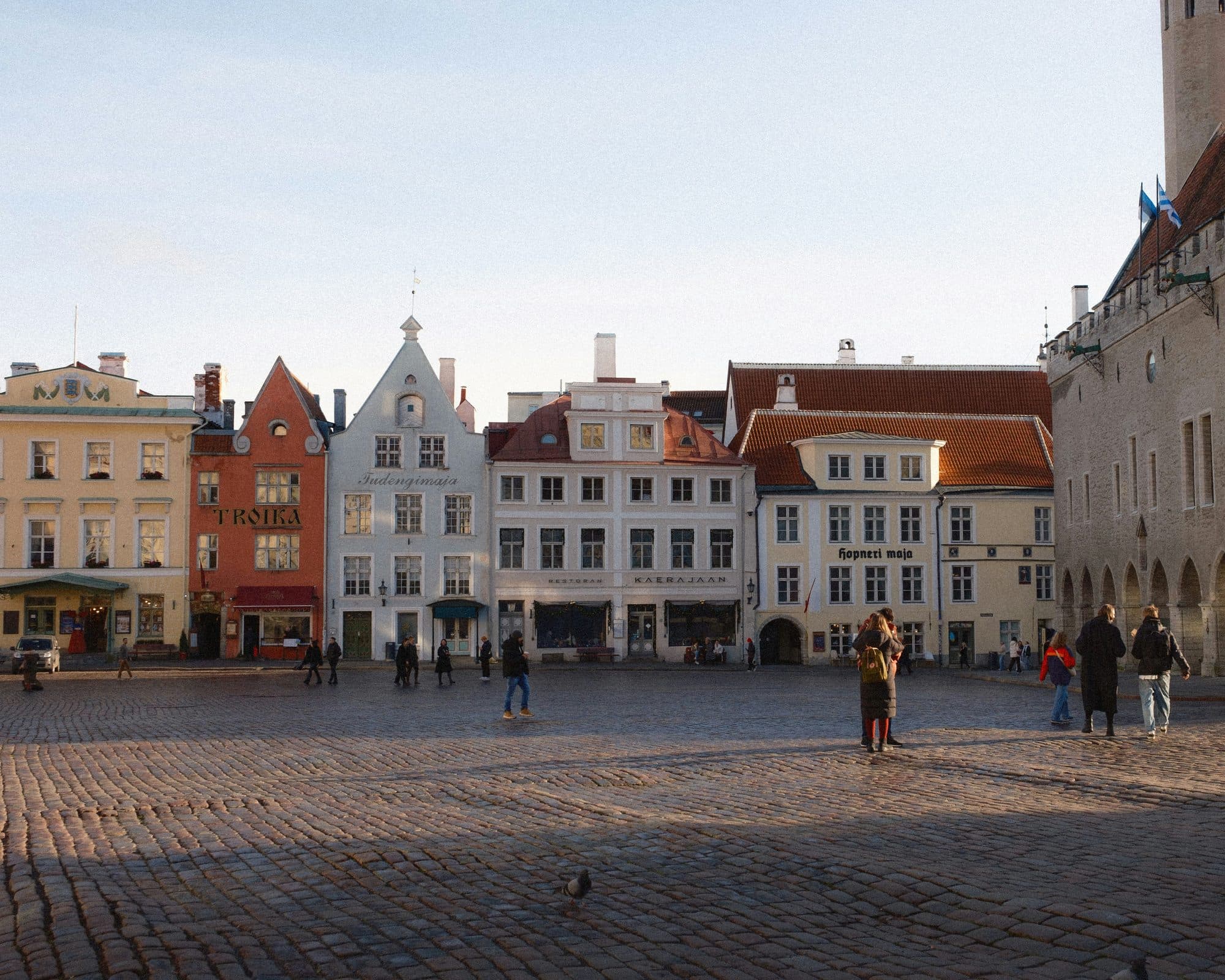
Tallinn is where most arrivals land and most jobs are, and the old town in the photograph is the part everyone sees first and almost nobody lives in. The city that matters for a newcomer is the ring of districts around it.
Estonia has two official counts and they disagree. The Population Register counts registered addresses; Statistics Estonia uses a residency-index method and produces higher numbers. The figure above is the Register's — the count you join when you register your address within 14 days of moving in.
On that count Tallinn grew sharply in 2022–23 as Ukrainians arrived (+13,374 in one year), plateaued, and fell for the first time in 2026, by 1,018. That mirrors the country: Estonia's population fell for a second consecutive year to 1,360,745, with net migration negative for the first time in over a decade.
Cost of Living
Tallinn is the most expensive Estonian city on every measure that is officially published, and the gap is widest in housing.
| Tallinn | Tartu | Pärnu | |
|---|---|---|---|
| Apartments, secondary market | €2,971.00/m² | €2,400.00/m² | €1,988.00/m² |
| New build | €4,583.00/m² | €4,338.00/m² | €3,815.00/m² |
| Typical two-room flat | €136,326 | €112,856 | €94,551 |
| District heating | €77.82/MWh | €62.41/MWh | €68.76/MWh |
| Water and sewerage | €2.87/m³ | €3.10/m³ | €3.84/m³ |
Tallinn's secondary-market square metre is 49% above Pärnu's and 24% above Tartu's. Heating and water, by contrast, are unremarkable — Tallinn sits in the middle of the four on both.
There is no official rent figure for Tallinn — or anywhere in Estonia. The purchase prices above are real, from the Land and Spatial Development Board's quarterly review. Rent is not published by anyone. The land board records transactions, not tenancies; Statistics Estonia publishes indices, not levels. Every Tallinn rent figure in circulation is portal or crowd-sourced data, so treat it as a listing price rather than a market rate. See cost of living for what is regulated and published.
Neighbourhoods
Tallinn has eight districts: Haabersti, Kesklinn, Kristiine, Lasnamäe, Mustamäe, Nõmme, Pirita and Põhja-Tallinn. The city's own heritage register describes the character of the older pockets within them, and those descriptions are quoted below because they are the only official ones that exist.
| Area | District | The city's own description |
|---|---|---|
| Kalamaja | Põhja-Tallinn | "Tallinn's oldest suburb" — centuries of wooden fishermen's housing |
| Kadriorg | Kesklinn | "Unique history and character", well-preserved 18th–20th century architecture |
| Nõmme | Nõmme | The "forest city" — Tsarist summer villas and interwar houses |
| Pelgulinn | Põhja-Tallinn | Railway-era development and 1920s cooperative housing |
| Uus Maailm | Kesklinn | An 1890s-onward suburban workers' district |
| Merivälja | Pirita | A 1924 garden city on an American-style grid |
What follows is description, not a sourced fact. Lasnamäe, Mustamäe and Väike-Õismäe are the big Soviet-era panel-block districts, and they are where the cheapest housing and most of the non-Estonian-speaking population are. Pirita is coastal, low-density and expensive. This is widely repeated and none of it traces to an official document — none of those three districts appears in the city's heritage register, only the pre-Soviet pockets inside them. Treat it as orientation, then go and look.
Job Market
The case for Tallinn
The economic case:
- Harju county: 63% of national GDP, GDP per capita 34% above the national average
- Average gross wage in the city €2,538, against €2,135 nationally
- Median in Harju county €1,958 — the highest of the four counties
- ICT roles are outside the immigration quota
What Harju actually runs on
The other side of the wage figures:
- Invest in Estonia names electronics, electrical equipment, metals, food, energy and logistics for Harju
- Northern Estonia ran 7.4% unemployment in the 2025 labour force survey
- Tech is concentrated here but is not counted separately by city, so treat any Tallinn tech headcount you are quoted as an estimate
The wage gap is the number to carry: the median in Harju is €1,958 against €1,407 in Ida-Viru — a 28% difference inside a country you can drive across in three hours. Use the salary calculator to see what any of it means after tax.
Getting Around
Public transport is free, and it is the reason to register your address on day one. It is free for anyone with a registered Tallinn address, using a personalised Ühiskaart and an ID. Also free: pre-school children, under-19s resident in Estonia, over-65s, and disabled people with a companion. Drivers do not sell tickets and cash is not accepted on board.
Everyone else pays by the ticket:
- One hour — €2.00
- 24 hours — €5.50
- 72 hours — €9.00
- 30 days — €30.00
Those are the fares for the city's own network, and they are a good deal lower than the monthly figures most often quoted for Tallinn. If you have seen a far higher monthly price, that is a different product. The city's mobility pages also list the Põhja-Eesti regional ticket — 30 days, €48.00 to €90.00 depending on how many zones you cross — which covers Tallinn plus Harju county. The city ticket is €30.00, and the regional product is where the higher figures in circulation come from.
Trains (Elron): about ten direct services a day to Tartu, fastest around 2 h 38 min; roughly five a day to Narva, 3 h 15 min to 3 h 40 min. There is no rail to Pärnu at all. One caution: Elron was running short-validity timetables and engineering works through 2026, so check the live timetable rather than planning on these.
Flying: Lennart Meri Tallinn Airport is the only Estonian airport with a real route map — airBaltic alone listed 25 direct destinations for summer 2026, and seven new routes launched during the year, including Warsaw, Rome, Düsseldorf, Leeds and London Gatwick.
Expat Life
Tallinn is the easiest landing in Estonia if you speak English and not Estonian. 81% of the city speaks at least one foreign language, and English overtook Russian as Estonia's most widely spoken foreign language between the 2011 and 2021 censuses.
| Service | Where | What it does |
|---|---|---|
| International House of Estonia | Tallinn | The state's newcomer service, run through Work in Estonia |
| Integration Foundation | Rävala 5 | Settle in Estonia adaptation programme, language courses |
| Estonian Language House | Tallinn and Narva | Free courses — see the language page |
Worth knowing before you compare cities: Tartu's welcome centre can actually perform registrations, including the personal ID code, and Tallinn's cannot. If paperwork is your main worry, that is a genuine point against the capital.
Climate & Winters
Monthly mean temperature, Tallinn-Harku station, 1991–2020 normals, from the Estonian Weather Service:
February is colder than January — at every Estonian station in the 1991–2020 normals, and it contradicts what most people expect. Tallinn's February mean is −3.6 °C against January's −2.9 °C, and the February mean minimum is −6.2 °C. The other number that matters is daylight: 5 h 48 min at midwinter against 18 h 42 min at midsummer. The dark, not the cold, is what people find hard.
Annual mean 6.4 °C, precipitation 700 mm, sunshine 1,923 hours a year — second only to Pärnu among the stations that publish it.
Practical Information
| Detail | |
|---|---|
| Register your address | Within 14 days, and it is what makes transport free and decides school priority. See renting. |
| Bank account | Proof of a connection to Estonia, in person, up to 10 business days. See bank accounts. |
| Health cover | Starts 14 days after your employer registers you. See health insurance. |
| Language | B1 for permanent residence and citizenship; free state courses have a Language House here. See the language page. |
| Heating | €77.82/MWh excluding VAT, Competition Authority approved. Ask for a January bill before you sign a lease. |
Related guides
Frequently Asked Questions
Is Tallinn expensive compared with the rest of Estonia?
Yes, and by a clear margin — it has the highest rents, the highest purchase prices per square metre and the highest wages in the country. The wage premium is what makes it worth it for most people; the rent is what surprises them.
Do I need Estonian to work in Tallinn?
Not in the international sector — tech, e-Residency services, shared-service centres and startups run in English. Outside that, and for anything dealing with the state or with customers, Estonian matters quickly.
Which neighbourhood should a newcomer look at first?
It depends entirely on whether you are commuting to the centre and whether you want a Soviet-era block or a renovated wooden house, which are the two dominant housing types and price very differently.
How bad is the winter?
Dark rather than extreme. The temperature is milder than the latitude suggests because the sea moderates it; the short daylight is the part people underestimate.
Can I live in Tallinn without a car?
Yes. Public transport is free for registered residents, which is unusual and worth registering for on its own.
Can I get my personal ID code or register my address in Tallinn?
Registering the address is a municipal matter and you have 14 days to do it — it is what makes transport free and what decides school priority. The personal ID code is the awkward part. Tallinn's International House of Estonia is the state's newcomer service, run through Work in Estonia, but it does not perform registrations. Tartu's Welcome Centre does: it takes personal identification code applications and registers residence within Tartu. If paperwork is your main worry, that is a genuine point against the capital.
Is there anywhere to take a landlord dispute in Tallinn?
Yes, and it is one thing Tallinn has that the rest of the country does not. The city runs a rent committee (üürikomisjon) under the Rental Dispute Resolution Act. Either side may apply, in writing, there is no state fee, and the city's own page puts the claim cap at €3,200. It is active rather than nominal — Tallinn publishes its 2026 decisions. Outside Tallinn the route is the county court.
Will my child still be taught in Russian in a Tallinn school?
Less and less. All state and municipal education is moving to Estonian-language instruction on a fixed schedule: basic school finishes in 2029/30 and upper secondary in 2032/33. Tallinn allowed 20 schools to keep Russian-language instruction in grades 7 to 9 for 2026/27, citing a shortage of teachers with C1 Estonian, and put €10.2 million behind the transition — but Russian-language classes in the city still fell from 566 in 2024/25 to 273 in 2026/27. A child may keep 2 lessons a week of their own language if at least 10 pupils at the school ask for it.
Are the free state Estonian courses available in Tallinn?
Yes, and this is one of only two places in the country they are. The Integration Foundation runs Estonian Language Houses in Tallinn and Narva and nowhere else — there is none in Tartu. Courses are free at A1 (100 hours), A2 (150 hours) and B1 in two parts (120 and 130 hours), alongside the Settle in Estonia adaptation programme. The constraint is supply, not price: a Ministry of Culture study found places fill within minutes of registration opening, and finishing one level gives you no claim on a place at the next.
Which Tallinn wage figure should I plan on?
Two numbers circulate and they measure different things. €2,538 is the average gross wage for the city in Q1 2026, against €2,135 nationally. €1,958 is the median for Harju county, against €1,753 nationally. Statistics Estonia publishes the median for every county but the average for only two of them, so a city average beside a county median is as close to like-for-like as anyone can get you. An average is pulled up by the top of the distribution — plan on the median.